
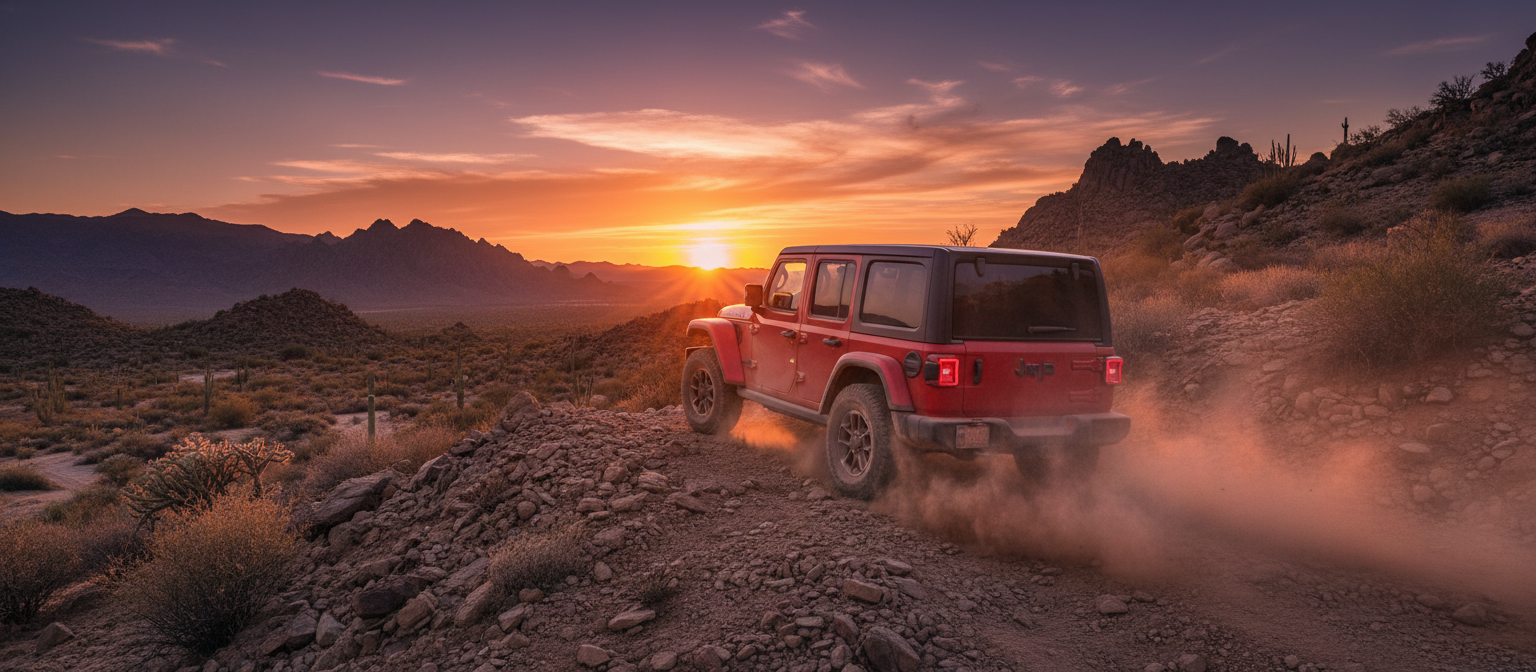
Choosing a vehicle that masters both the Highway 74 commute and the rugged Bee Canyon wash requires a specific strategy. For those seeking Jeep Wrangler Southern California trail capability, the decision often comes down to matching mechanical hardware with your specific weekend goals in the Inland Empire.
Living in Hemet, you aren’t just buying an SUV; you are investing in a tool for geographic freedom. Whether you are navigating the morning rush on Florida Avenue or airing down your tires at a trailhead, your Wrangler must handle heat, dust, and steep inclines with equal composure.
This guide resolves the “spec-paralysis” often felt when comparing trims like the Rubicon, Sahara, and Willys. We will break down exactly which features matter for our local Mediterranean climate and granite-heavy topography.
The “Trail-to-Tarmac” Decision
Before looking at window stickers, you need to identify your “Dirt-to-Pavement Ratio.” In our region, terrain varies wildly from the soft sands of Truckhaven to the sharp, technical rocks near Idyllwild.
You might be the Tactical Trekker. This driver lives for the “technical” stuff—think steep grades and loose shale where wheel placement is everything. For you, mechanical locks are more than a luxury; they are your insurance policy against getting stuck miles from the nearest paved road in Murrieta.
Alternatively, you may be the Scenic Surveyor. You want the wind in your hair on the way to a Temecula vineyard, but you still want the ability to duck into a fire road without a second thought. You prioritize cabin insulation and road manners. View New Inventory
Matching the Wrangler to Your SoCal Lifestyle
| If You’re This Buyer | Consider This | Why It Fits |
|---|---|---|
| Rock Crawler & Explorer | Rubicon | Locking diffs and sway-bar disconnects master steep San Jacinto inclines. |
| The Daily Commuter | Sahara | Improved insulation and Selec-Trac 4WD handle Hwy 79 traffic comfortably. |
| The Value Adventurer | Willys | High ground clearance and 33-inch tires offer great capability for fire roads. |
The Rubicon remains the gold standard for those eyeing the boulders of Joshua Tree. However, many Hemet drivers find the Willys offers the perfect middle ground, providing heavy-duty shocks that soak up the “washboard” ripples common on local desert access roads. View Used Inventory
Real-World Performance in the Inland Empire
The reality of driving in the San Jacinto Valley involves unique stressors, specifically heat and wind. When you are climbing toward the San Bernardino National Forest, the 2.0L Turbo and 3.6L V6 engines manage cooling differently.
Experienced Hemet off-roaders usually discover that the low-end torque of the Turbo is a dream for crawling, but the naturally aspirated V6 offers a linear power delivery that feels more predictable on the long, hot ascent of the 74. Heat management is the primary concern here.
Inside the cabin, the modern Uconnect system with Apple CarPlay is a literal lifesaver. After a long day of high-concentration driving through dusty washes, the ability to have a clear navigation path back to Hemet is the emotional relief every adventurer needs.
Ownership Reality and Long-Term Confidence
A common anxiety for new Jeep owners is the transition from “trail beast” on Saturday to “work vehicle” on Monday. You might worry about dust intrusion or the physical toll of a stiff suspension on our occasionally potholed rural roads.
Modern Wranglers have solved the “noise fatigue” of the past. Hardtop options and improved seals mean the Santa Ana wind gusts won’t make your commute feel like a wind tunnel. By year three, you will appreciate the high resale value Wranglers maintain in Southern California.
Maintenance is straightforward, but the dusty environment of the Inland Empire means air filter checks should be more frequent than the manual suggests. This ensures your Wrangler remains a reliable escape pod for years to come. About Us
Common Questions About Jeep Wrangler Southern California Trail Capability in Hemet
Which Jeep Wrangler trim is best for Hemet area trails?
The Rubicon is best for technical rock crawling near Idyllwild due to its locking differentials. However, for most fire roads and seasonal trails around Bee Canyon, the Willys trim offers the perfect balance of ground clearance and value for local adventurers.
How does the Jeep Wrangler handle the summer heat in Southern California?
Modern Wranglers are engineered with high-capacity cooling systems designed for desert environments. Whether you are idling in Moreno Valley traffic or climbing a steep grade in 100-degree weather, the engine management system prioritizes airflow to prevent overheating.
Is a soft top or hardtop better for driving in the Inland Empire?
A hardtop is generally recommended for Hemet drivers to combat Santa Ana wind noise and provide better insulation against the summer heat. While soft tops offer easier open-air access, the hardtop provides a much quieter experience on the Highway 74 corridor.
Do I need 4-Low for most trails around San Jacinto and Hemet?
While many local fire roads are navigable in 4-High, 4-Low is essential for the steep, silty inclines found in the San Jacinto foothills. Using 4-Low reduces strain on your transmission and provides the controlled torque needed to climb safely.
Finding Your Perfect Trail Partner
The ultimate Southern California adventure starts with a vehicle that removes the “what-if” from your weekend plans. Knowing you have the right tool for the terrain provides the peace of mind to explore further and stay out longer.
If you’re ready to see how these features feel on the road—and off it—our team is here to help you dial in your perfect setup. Contact Us or Schedule Service today.
Connect with us

