
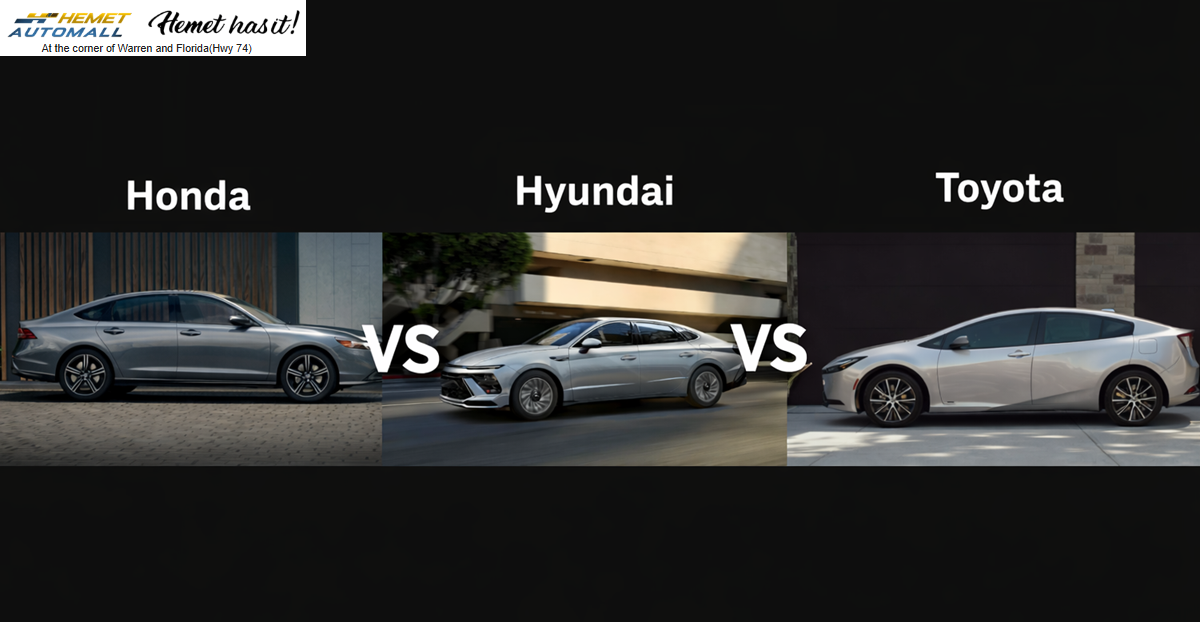
Honda vs Hyundai vs Toyota: Compare Reliability, Cost, and Features in Hemet, CA
Toyota, Honda, and Hyundai consistently rank among the top-selling car brands in the United States — and for good reason. All three have built strong reputations for reliability, fuel efficiency, and value. But when it comes time to actually choose between them, the differences can feel hard to pin down.
This guide breaks down how the three brands compare across the areas that matter most to buyers in Hemet, San Jacinto, Menifee, and the broader Inland Empire: reliability, cost of ownership, warranty coverage, and which models tend to fit which lifestyles. No brand favoritism here — just a practical comparison to help you make the right call for your situation.
Reliability — How Do the Three Brands Stack Up?
Reliability is often the first thing people think about when choosing between Toyota, Honda, and Hyundai — and all three perform well in this category, though in slightly different ways.
Toyota has long held a reputation for building vehicles that go the distance. Models like the Camry, Corolla, and RAV4 regularly appear on industry reliability rankings from organizations like J.D. Power and Consumer Reports. Many Toyota owners in the San Jacinto Valley and Inland Empire drive their vehicles well past 200,000 miles with routine maintenance — a common story you’ll hear at service centers along Florida Avenue and across Riverside County.
Honda has a similar track record. The Civic, Accord, and CR-V have earned a loyal following among buyers who value engineering quality and driving feel. Honda vehicles tend to hold their value well on the resale market, which is worth considering if you plan to trade in or sell your vehicle down the road.
Hyundai has made significant improvements in reliability over the past decade. Newer models like the Tucson, Elantra, and Sonata have performed strongly in independent quality surveys. While Hyundai’s reputation is still catching up to Toyota and Honda in some buyers’ minds, the vehicles themselves have narrowed the gap considerably.
💡 Did You Know? Resale value is directly tied to reliability perception. According to industry trends, Toyota vehicles tend to retain a higher percentage of their original value after five years compared to most competitors — which means you may get more back when it’s time to trade in or sell.
Cost of Ownership — Purchase Price, Insurance, and Maintenance
The purchase price is just the starting point. What you pay over the life of the vehicle — in maintenance, insurance, fuel, and depreciation — is what really determines the true cost of ownership.
Purchase price. Hyundai generally positions itself as the more value-oriented option compared to Toyota and Honda for comparable models. For example, a base-model Hyundai Tucson is typically positioned below a comparably equipped RAV4 or CR-V. This can be a meaningful difference for budget-conscious buyers, especially first-time buyers or families in the Inland Empire looking to get more for their money.
Maintenance costs. All three brands are generally affordable to maintain compared to European or luxury brands. Toyota and Honda have a slight edge in the availability of independent mechanics who specialize in their vehicles — though with Hyundai’s growing market share, this gap has narrowed. Routine maintenance like oil changes, brake pads, and tire rotations are comparable across all three brands.
Insurance. Insurance rates depend on the specific model, your driving record, and your location, but generally speaking, all three brands fall within a similar range for standard models. SUVs tend to cost slightly more to insure than sedans across all three brands — something to factor in if you’re comparing a Tucson against a Toyota Camry, for instance.
Depreciation. Toyota tends to depreciate more slowly than Honda and Hyundai, which means stronger resale value when you’re ready to move on. Honda holds its value well too. Hyundai’s depreciation rate is typically steeper in the first few years, but that also means you can find strong deals on used or certified pre-owned Hyundai models — so depreciation can actually work in your favor depending on whether you’re buying new or used.
Warranty — Where Hyundai Has a Clear Edge
This is one area where the three brands differ significantly, and it’s worth paying attention to — especially if peace of mind matters to you.
Hyundai offers what is widely considered one of the more comprehensive warranty packages available: 5 years / 60,000 miles of bumper-to-bumper coverage and 10 years / 100,000 miles of powertrain coverage. For a first-time buyer or someone concerned about unexpected repair costs, this can provide significant reassurance.
Toyota offers 3 years / 36,000 miles of bumper-to-bumper and 5 years / 60,000 miles of powertrain coverage. Toyota also includes 2 years / 25,000 miles of complimentary scheduled maintenance (ToyotaCare) on new vehicles, which covers oil changes and tire rotations during that period.
Honda offers 3 years / 36,000 miles of bumper-to-bumper and 5 years / 60,000 miles of powertrain coverage — essentially matching Toyota’s structure without the complimentary maintenance component.
The takeaway: if warranty length is a major factor for you, Hyundai’s 10-year powertrain coverage stands out. If you prioritize long-term reliability and resale value, Toyota and Honda’s track records speak for themselves. There’s no wrong answer — it depends on what gives you the most confidence.
💡 Quick Tip: Warranty coverage applies to the original buyer. If you’re buying a used vehicle, check how much of the original warranty remains. Hyundai’s 10-year powertrain warranty, for example, is reduced to 5 years / 60,000 miles for second owners — still competitive, but worth knowing before you buy.
Best Models for Families, Commuters, and First-Time Buyers
All three brands offer a wide range of models, but certain vehicles tend to be a better fit depending on your lifestyle. Here’s a practical breakdown for the most common buyer profiles in the Hemet, Menifee, and Inland Empire area.
For families who need space and versatility: The Honda CR-V, Toyota RAV4, and Hyundai Tucson are the three most cross-shopped compact SUVs in the country — and all three deliver a strong combination of cargo space, fuel efficiency, safety features, and comfortable back seats for kids and car seats. If you need a third row, the Toyota Highlander, Honda Pilot, and Hyundai Palisade are worth exploring as well.
For commuters focused on fuel economy: If you’re driving the I-215 corridor between Menifee and Riverside every day, or commuting through the Perris Valley and up through the Box Springs Pass, fuel economy adds up fast. The Toyota Camry and Honda Civic are both proven long-distance commuter vehicles with strong highway fuel ratings. The Hyundai Elantra is a competitive option as well, offering similar fuel efficiency with a value-oriented positioning.
For first-time buyers on a budget: The Hyundai Elantra, Toyota Corolla, and Honda Civic are all solid choices for someone buying their first car. The Elantra is typically the most value-oriented of the three, the Corolla is widely known for its long-term durability, and the Civic offers a balance of fun driving dynamics and practicality. All three are widely available as pre-owned vehicles as well.
For buyers who want hybrid options: All three brands have been expanding their hybrid lineups. The Toyota RAV4 Hybrid has been a strong seller, the Honda CR-V Hybrid has gained traction in recent years, and the Hyundai Tucson Hybrid offers a compelling value proposition. If lowering your fuel costs on those long Inland Empire commutes matters to you, all three are worth test driving.
How to Decide — and the Easiest Way to Compare All Three
Here’s the reality: Toyota, Honda, and Hyundai are all strong choices. You’re unlikely to make a bad decision choosing any of the three. The question is which one fits your specific priorities.
If long-term resale value and a proven reliability track record are your top priorities, Toyota is hard to beatIf driving feel, engineering refinement, and a balance of value and quality matter most, Honda is consistently strongIf you want strong warranty coverage and competitive pricing at entry level, Hyundai deserves a close look
The best way to decide? Drive all three. Sit in the seats. Put your car seat in the back. Feel the steering on Highway 74. Compare the dashboards side by side. Reading specs online is helpful, but nothing replaces the experience of actually being in the vehicle.
At Hemet Auto Mall, Toyota, Honda, and Hyundai are all on the same campus — along with Ford, Chevrolet, Nissan, Jeep, RAM, and Dodge. You can test drive a RAV4, walk across the lot to the Honda side and drive a CR-V, and then head over to Hyundai for the Tucson — all in the same visit. No extra driving, no wasted time, no having to remember what the first one felt like by the time you get to the third.
💡 Did You Know? Highway 74 runs directly past Hemet Auto Mall and continues east as the Palms to Pines Scenic Byway into the San Jacinto Mountains. If you want to test how your potential new SUV handles mountain grades, you can literally drive it up to Idyllwild and back during your test drive — one of the more scenic test drive routes in Southern California.
Frequently Asked Questions About Toyota vs. Honda vs. Hyundai
Which is more reliable: Toyota, Honda, or Hyundai?
All three brands perform well in reliability. Toyota and Honda have longer track records and consistently rank at or near the top in independent reliability surveys. Hyundai has improved significantly over the past decade and now competes closely with both. The right choice depends on the specific model and your priorities.
Which brand is cheapest to maintain: Toyota, Honda, or Hyundai?
Maintenance costs are generally comparable across all three brands for routine services like oil changes, brake pads, and tire rotations. All three are more affordable to maintain than European or luxury brands. Toyota and Honda have a slight edge in the availability of specialized independent mechanics, though Hyundai’s service network has grown considerably.
Which brand has the best warranty: Toyota, Honda, or Hyundai?
Hyundai offers one of the more comprehensive warranty packages in the industry with 5 years / 60,000 miles bumper-to-bumper and 10 years / 100,000 miles powertrain coverage. Toyota and Honda both offer 3 years / 36,000 miles bumper-to-bumper and 5 years / 60,000 miles powertrain. Toyota also includes 2 years of complimentary scheduled maintenance on new vehicles.
Toyota RAV4 vs Honda CR-V vs Hyundai Tucson — which SUV is better for families?
All three are strong family SUVs with competitive cargo space, safety ratings, and fuel efficiency. The RAV4 tends to hold its resale value well, the CR-V is known for its interior space and driving refinement, and the Tucson is often positioned as the more value-oriented option with a longer warranty. Test driving all three is the most effective way to determine which one fits your family’s specific needs.
Where can I test drive a Toyota, Honda, and Hyundai in one visit?
Hemet Auto Mall in Hemet, CA has Toyota, Honda, and Hyundai dealerships on the same campus, along with Ford, Chevrolet, Nissan, Jeep, RAM, and Dodge. You can test drive vehicles from all three brands in a single visit without driving to multiple locations. The auto mall is located at the corner of Warren and Florida (Hwy 74) in Hemet.
Which brand holds its value better: Toyota, Honda, or Hyundai?
Toyota generally leads in resale value, retaining a higher percentage of its original value after five years compared to most competitors. Honda also holds its value well. Hyundai typically depreciates faster in the early years, which can make it a strong option for used car buyers looking for a newer vehicle with more features for their budget.
Does Hemet Auto Mall have bilingual staff?
Yes. Hemet Auto Mall has bilingual staff across all departments — sales, financing, and service. Toda la experiencia de compra está disponible completamente en español.
Compare Toyota, Honda, and Hyundai in One Visit at Hemet Auto Mall
All three brands are available on the same campus at the corner of Warren and Florida (Hwy 74) in Hemet, CA — along with Ford, Chevrolet, Nissan, Jeep, RAM, and Dodge. Walk between lots, test drive back to back, and find the right fit for your budget and your lifestyle. Bilingual staff available across all departments. Check current special offers before your visit.
Connect with us

